
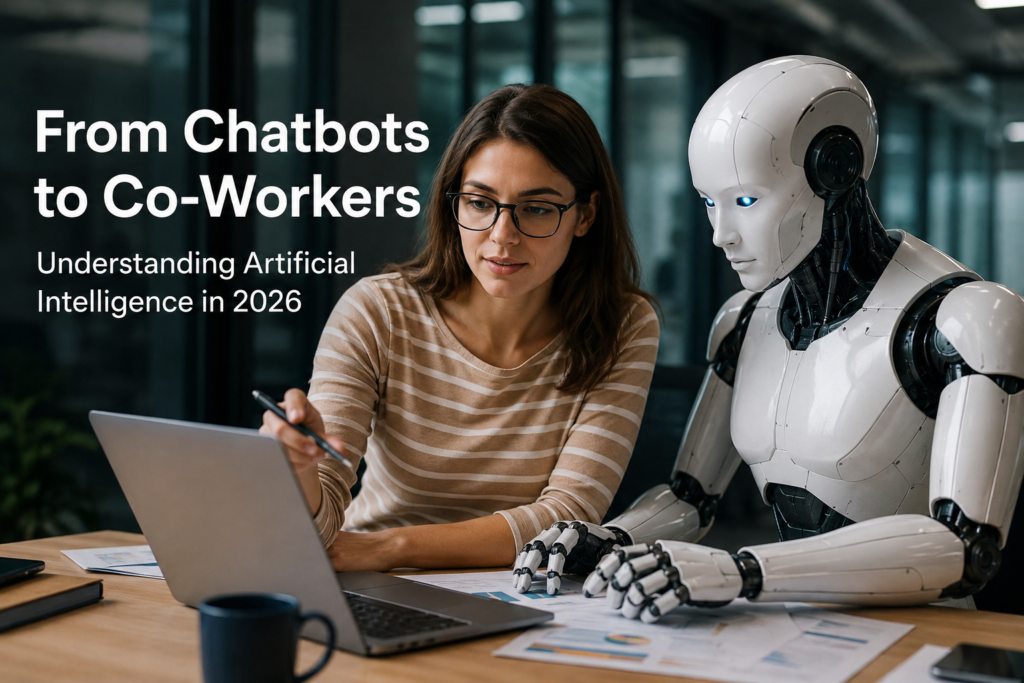

Introduction: The AI You Already Use
Here’s a confession: I spent weeks arguing with my AI assistant about the best route to a friend’s wedding. It kept suggesting the highway; I insisted on the scenic coastal road. It turned out to be right construction had gridlocked my preferred route. I arrived on time, grumbled, and realized something: I had been treating artificial intelligence like a stubborn backseat driver, not the sophisticated tool it actually is.
That moment made me wonder how many of us are using Artificial Intelligence every day without really understanding what it is or how it works?
Artificial Intelligence (AI) is technology that enables computers and machines to simulate human learning, comprehension, problem solving, decision making, creativity and autonomy. But that definition only scratches the surface. In 2026, AI is no longer a futuristic concept reserved for sci-fi movies or research labs. It’s the invisible layer quietly shaping how we work, learn, shop, and even grieve.
This beginner’s guide cuts through the hype to explain what AI really means in 2026 in plain language, with no technical background required.
What Exactly Is Artificial Intelligence?
Artificial Intelligence is a field of computer science dedicated to creating systems that can perform tasks typically requiring human intelligence like visual perception, speech recognition, decision-making, and language translation.
But here’s the nuance that often gets lost: AI is not one thing. It’s a bundle of ideas and methods from computer science, neuroscience, psychology, philosophy, language science, and math, all working together to build systems that can learn, reason, and make decisions.
Think of AI as a toolbox rather than a single gadget. Inside that toolbox, you’ll find:
- Machine Learning: Systems that learn from data without being explicitly programmed for each task
- Deep Learning: A subset that uses artificial neural networks to process massive amounts of data
- Generative AI: Systems that create new content text, images, audio, video rather than just analyzing existing data
- Agentic AI: Systems capable of planning, reasoning, and completing multi-step tasks with minimal human intervention
How Does AI Actually Work?
At its core, AI works by recognizing patterns in data. An AI system observes its environment, processes information using rules or models, and selects actions to achieve goals. It doesn’t “think” or “feel” it makes predictions based on input and its built-in assumptions.
Imagine teaching a child to identify dogs. You show them many pictures of dogs, point out the common features (four legs, tail, fur), and correct them when they mistake a cat for a dog. Over time, the child learns to recognize dogs independently.
AI learns similarly but at massive scale. Instead of showing a child dozens of pictures, you feed an AI system millions of images. Instead of a human pointing out features, the AI identifies patterns itself through mathematical calculations. The result? An AI that can recognize a dog in a photo faster and more accurately than most humans.
The Training vs. Inference Distinction
In 2026, a major shift is underway. By 2026, most AI computing is spent on inference (using trained models to make predictions) rather than training (building those models from scratch). Organizations are focusing more on deploying models efficiently, optimizing hardware, and lowering the cost per prediction.
Think of it this way: training is like writing a cookbook; inference is like using that cookbook to cook meals every day. In 2026, we’re spending more time cooking than writing new cookbooks.
AI vs. Search Engines: What’s the Difference?
One of the most common misconceptions is confusing AI with search engines. Here’s the distinction:
| Aspect | Search Engine | Artificial Intelligence |
|---|---|---|
| Primary Function | Finds and retrieves existing information | Generates new insights, content, or decisions |
| How It Works | Matches keywords to indexed web pages | Processes data through trained models to make predictions |
| Output | Links to sources | Original responses, recommendations, or creations |
| Example | Google Search | ChatGPT, Claude, Gemini |
While many search engines now include AI elements, they fundamentally do different things. A search engine is like a librarian who knows where every book is. AI is like a research assistant who can read all those books, synthesize their ideas, and write a new analysis.
What Can AI Do in 2026?
The capabilities of AI in 2026 extend far beyond chatbots and recommendation algorithms. Here’s what’s happening right now:
1. Agentic AI: From Answering to Doing
Perhaps the biggest change in 2026 is that AI is no longer being presented primarily as a chatbot. Instead, AI agents appear throughout the industry, with systems increasingly capable of planning, reasoning, and completing multi-step tasks with limited human intervention. The shift is from answering questions to accomplishing tasks.
AI models are evolving from predictive assistants to full-scale agents that can plan actions, make decisions, integrate with enterprise tools, and complete business tasks end-to-end.
2. Domain-Specific Models
The Focus of industrialization of large models is shifting from general-purpose to vertical, domain-specific applications. Domain-specific models help organizations achieve improved accuracy and efficiency at lower costs. Instead of one AI that tries to do everything, we now have specialized AIs for healthcare, finance, manufacturing, and logistics.
3. Multimodal Capabilities
In 2026, generative AI has expanded beyond text and images into real-time video, speech, and interactive simulations. Multimodal systems can process and generate multiple forms of data simultaneously text, images, audio, and video.
4. AI in Everyday Life
From the way people navigate traffic and consume content to how doctors detect disease and banks identify fraud, AI is becoming an increasingly invisible but powerful layer of modern life. Health apps use AI to track sleep, heart rate, and physical activity, warning users about potential health problems before they become serious. Students use AI to simplify study sessions by summarizing lecture notes and organizing research.
What’s Next for AI?
As of July 2026, several trends are shaping AI’s future:
AI Governance Is Becoming a Global Priority. In July 2026, representatives from 170 countries convened in Geneva for the inaugural Global Dialogue on AI Governance. The UN Secretary-General outlined four priorities: safety, human rights, capacity, and transparency.
Inference Will Dominate AI Compute. By 2026, most AI computing is spent on inference rather than training, with organizations focusing on deploying models efficiently.
Physical AI Is Emerging. Gartner predicts that physical AI will automate up to 50% of manual industrial tasks by 2028. Humanoid robots are no longer just walking and dancing—they’re being designed to perceive surroundings and perform useful work.
AI Is Becoming the Top Investment Priority. For the first time, artificial intelligence has solidified its position as the top technology investment priority in every measured international region.
How to Start Using AI Today
If you’re new to AI, here’s how to begin:
- Start with a free AI assistant. Try ChatGPT, Claude, or Google Gemini for everyday tasks like drafting emails, planning trips, or summarizing articles.
- Learn effective prompting. The quality of AI output depends on how well you guide it. Be specific about what you want.
- Verify everything. Remember the core rule: AI is a tool. Primary sources are the authority. Verify claims that matter.
- Protect your privacy. Be mindful of what information you share with AI systems.
- Stay curious. The AI landscape is evolving rapidly. What’s true today may change tomorrow.
Conclusion
Artificial Intelligence in 2026 is not the sci-fi fantasy of machines taking over the world. It’s a practical, powerful tool that’s already woven into the fabric of daily life from the route suggestions that get you to weddings on time to the health apps that monitor your sleep and the assistants that help you write and create.
Understanding AI doesn’t require a computer science degree. It requires curiosity, healthy skepticism, and a willingness to experiment. AI is a tool and like any tool, its value depends on how well you use it.
The question isn’t whether AI will change your life. It already has. The question is whether you’ll understand it well enough to use it wisely.
What’s Your Experience with AI?
Have you used AI without realizing it? What questions do you still have about how it works? Share your thoughts in the comments below I’d love to hear about your AI journey.
Want to dive deeper? Check out our related guide on AI prompting techniques or explore how businesses are using AI in 2026.
This guide was researched and written in July 2026, drawing on the latest reports from the 2026 World Artificial Intelligence Conference, Gartner, the UN Global Dialogue on AI Governance, and IBM’s 2026 AI Guide.