
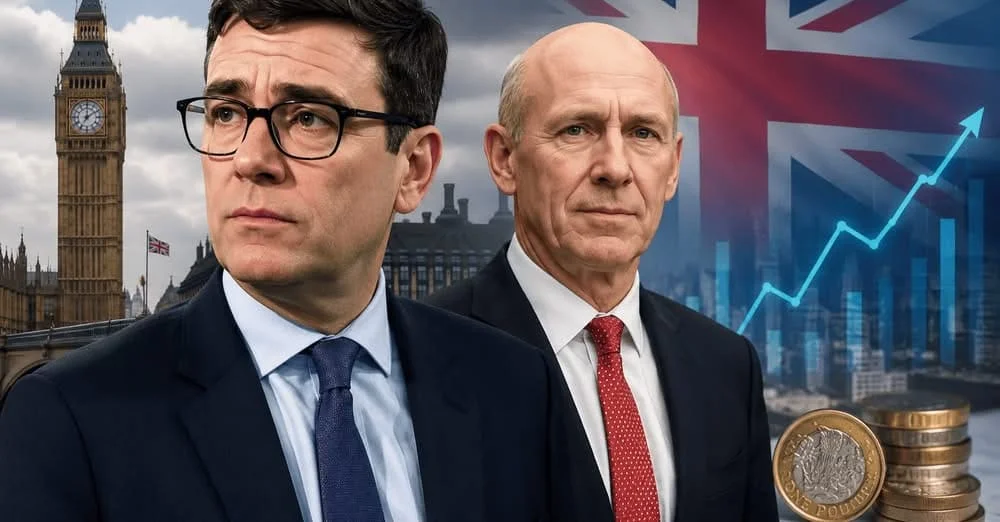

The door of Number 10 Downing Street had barely closed behind Britain’s seventh Prime Minister in a decade when Andy Burnham delivered his first major surprise. In a move that stunned Westminster insiders and global markets alike, Burnham appointed John Healey his predecessor’s former Defence Secretary as Chancellor of the Exchequer.
This wasn’t just a cabinet reshuffle; it was a statement. With John Healey appointed as top finance official, Burnham has signalled a decisive break from the Keir Starmer era while simultaneously raising profound questions about the future direction of the UK economy. But will this unexpected pairing prove to be the game-changer Britain desperately needs, or does it risk repeating the fiscal missteps of the past? Let’s dig deeper.
A Surprise That Calmed the Markets
When Burnham hinted on his first morning in office that he would exploit “any flexibility” within the government’s fiscal rules, bond markets reacted with immediate jitters. UK government borrowing costs spiked, with 10 year gilt yields jumping eight basis points to 5.049%.
Then came the Healey announcement and the markets exhaled.
Unlike Ed Miliband, whose past enthusiasm for borrowing to fund green investments had long worried investors, Healey was instantly framed as a “safe pair of hands”. His prior experience in the Treasury under Gordon Brown, including stints as Economic Secretary and Financial Secretary between 2002 and 2007, gave him a credibility that other candidates lacked. Sterling ticked higher, and gilt yields stabilised.
As Richard Carter, head of fixed interest research at Quilter Cheviot, put it: “Healey brings Treasury experience and is a sign that Burnham will respect the bond markets as a check on his radicalism”.
But here’s the rub markets may have calmed, but they haven’t been convinced. Not yet.
The Man Who Quit the Treasury Now Runs It
To understand why John Healey appointed as top finance official is so fascinating, you have to appreciate the irony. Just over a month before his appointment, Healey dramatically resigned as Defence Secretary, penning a blistering resignation letter that blamed the Treasury for being “unwilling” to commit the resources the nation needed. He accused his then-boss, Keir Starmer, of being “unable” to fund defence adequately.
Now, the man who spent years pushing to loosen the Treasury’s purse strings is the one holding them.
This isn’t the typical Chancellor appointment. Healey isn’t an economist or a City insider. He’s a Labour veteran who has held portfolios across housing, health, local government, and defence. He was first elected to Parliament in 1997 and has served in the governments of Tony Blair and Gordon Brown, as well as the shadow cabinets of Ed Miliband and Jeremy Corbyn.
He is, by all accounts, a loyal party man but also a man who has never been afraid to walk away when his principles were compromised.
A Chancellor for Burnham’s Vision, Not His Own
So what does Healey actually believe on the economy? The honest answer is: we don’t fully know yet and that may be precisely the point.
As Harry Woolman of Validus Risk Management observed, Healey “is widely regarded as a safe pair of hands who is likely to deliver on Burnham’s agenda rather than pursue an agenda of his own”. In other words, John Healey appointed as top finance official doesn’t mean Healey is setting economic policy. Andy Burnham is.
And Burnham’s vision is anything but cautious.
The new Prime Minister has promised the “biggest changes in the last 40 years” to British politics. He wants to reverse what he describes as the wrong turns of the 1980s—the centralisation of political power, the privatisation of public utilities, and the deindustrialisation of large parts of the country. His agenda includes bringing water, housing, energy, and transport under more public control, reindustrialising Britain, and devolving significant fiscal powers to regional mayors.
Healey, for his part, has signalled alignment. Speaking to broadcasters, he said the pair will “work in lockstep to meet the fiscal rules with a buffer against uncertainty” and focus on making “life more affordable for working people right across the UK”.
The First Test: A Tax Cut and a Promise
The Burnham-Healey era didn’t waste time getting started. Within 24 hours, the new government announced its first policy: VAT on domestic electricity bills would be cut from 5% to zero from October, saving the average household around £45 a year. The cost approximately £850 million in 2026-27 would be funded by scrapping Starmer’s Digital ID programme.
It’s a modest gesture, but a politically significant one. It signals “breathing space” for households struggling with the cost of living a phrase Burnham has used repeatedly.
Yet questions are already emerging. Former minister Darren Jones claimed on social media that the Digital ID policy had not been fully funded, raising doubts about whether the VAT cut is genuinely paid for. If the new government is already bending its own fiscal rules on day two, what happens when the really big bills arrive?
The Fiscal Elephant in the Room
Healey inherits a fiscal position that the Financial Times describes as “pretty tough”. Rachel Reeves, the previous Chancellor, had doubled her fiscal headroom to around £23 billion in her last budget. But since then, the Iran war, higher inflation, and broader economic pressures have likely halved that buffer. Public finances are stretched, with day to day spending already £42 billion in the red for the first three months of the tax year.
On top of that, Burnham has made a string of expensive promises:
- Raising defence spending to 3% of GDP by 2030 up from around 2.7% which could cost an extra £10 billion a year.
- Keeping the triple lock on the state pension, which costs an estimated £13 billion more than a less expensive alternative.
- Tackling the social care crisis a multi-billion-pound challenge that successive governments have dodged.
- Potentially raising the income tax personal allowance, which has been frozen at £12,570 since 2021. (If it had risen with inflation, it would now be £16,070.)
As David Zahn, head of European fixed income at Franklin Templeton, bluntly observed: “You’re starting to talk about quite a bit of money”.
Defence Bonds, Tax Hikes, or Something Else?
So how will Healey pay for it all?
One option that has excited investors is the possibility of “defence bonds” government borrowing earmarked specifically for military investment, an idea Healey has previously backed. UK defence companies have already seen a £4 billion boost to their market value since his appointment. The Tories have dismissed the idea as a “total gimmick”, but it remains on the table.
Other possibilities include:
- A wealth tax, which Burnham has declined to rule out.
- Further rises in capital gains tax.
- Increased windfall taxes on oil and gas companies Healey has previously voted in favour of this.
But there’s a deeper question here that goes beyond specific policies.
Burnham vs Healey: Who’s Really in Charge?
Nigel Green, CEO of deVere Group, has issued a stark warning to investors: “Healey does not set the direction of this government, Burnham does”. Green argues that John Healey appointed as top finance official is “not evidence the pressure to spend has gone away. It is evidence Burnham knows the market needed reassurance while he works out how far he can push”.
In other words, Healey isn’t a brake on Burnham’s ambitions. He’s an enabler.
Others are more optimistic. The appointment of Emma Reynolds as Chief Secretary to the Treasury further strengthens what some analysts describe as a “fiscally orthodox finance team”. There’s a view that Healey’s Treasury experience will temper Burnham’s more radical instincts, even if he shares his boss’s overall vision.
The truth probably lies somewhere in between. Healey isn’t a fiscal conservative in the traditional sense he resigned precisely because he wanted more spending on defence. But he also understands how the machinery of government works, and he knows that markets have a long memory.
What This Means for You
For the average UK household, the early signals are mixed.
The VAT cut on electricity bills is welcome, but it’s small beer compared to the broader cost of living crisis. If Burnham follows through on raising the personal allowance, millions could pay less income tax. But that could also mean cuts elsewhere potentially in welfare spending, an area where Healey has few public commitments.
For homeowners, there’s speculation that Burnham supports replacing Stamp Duty and Council Tax with an annual property tax of 0.48% of a home’s value. For a £300,000 property, that would mean an annual charge of £1,440 a significant shift that could reshape the housing market.
For businesses, the promise of reindustrialisation and devolution is intriguing. But the uncertainty around fiscal policy will there be tax hikes? How much borrowing? is likely to keep investment decisions on hold until the autumn budget provides clarity.
The Verdict: Game-Changer or False Dawn?
So, is John Healey appointed as top finance official a game changer for the UK economy?
The appointment itself is certainly a game-changer in political terms. It signals that Burnham is serious about breaking with the Starmer era and pursuing a more interventionist, devolved economic model. Healey brings credibility, experience, and a personal history of standing up for what he believes in even when it cost him his job.
But whether this translates into genuine economic transformation depends on two things.
First, can Burnham and Healey reconcile their ambitions with the fiscal reality? The UK’s public finances are stretched, and the bond market is watching closely. One wrong move a signal that fiscal discipline is slipping could send borrowing costs soaring and undo any good work.
Second, can they deliver growth? Without a significant pick-up in economic growth, the math simply doesn’t work. Burnham’s promises of reindustrialisation and devolution are bold, but they’re also unproven. As the BBC noted before his appointment, Burnham’s “Manchesterism” offers a diagnosis of what’s gone wrong but “is not yet a full economic plan”.
Healey has a chance to provide that plan. But he’s starting from a position of weakness, not strength.
What Do You Think?
Andy Burnham’s new chapter is only just beginning, and John Healey appointed as top finance official is the first and perhaps most important plot twist. Will this unlikely partnership deliver the economic renewal Britain needs, or will it buckle under the weight of its own ambitions?
I’d love to hear your perspective. Drop a comment below, share this post with someone who follows UK politics, or subscribe to our newsletter for more in depth analysis as this story develops.
The game is afoot. Let’s watch closely.
Written by by The Everyday Scroll | AI & Security Expert | 4+ years in fintech & tech. Not financial advice always consult a qualified advisor.