
Introduction: The Developer Is No Longer Working Alone
Imagine opening your project in the morning, describing a feature in plain English, and having an AI agent inspect the repository, identify the relevant files, implement the feature, run tests, fix errors, and prepare a pull request.
That sounds futuristic, but it is increasingly becoming part of everyday software development.
The important change isn’t simply that AI can write code. Developers have had access to code-generation tools and programming chatbots for years. The bigger shift is that newer AI coding agents can take action inside development environments rather than simply responding to questions.
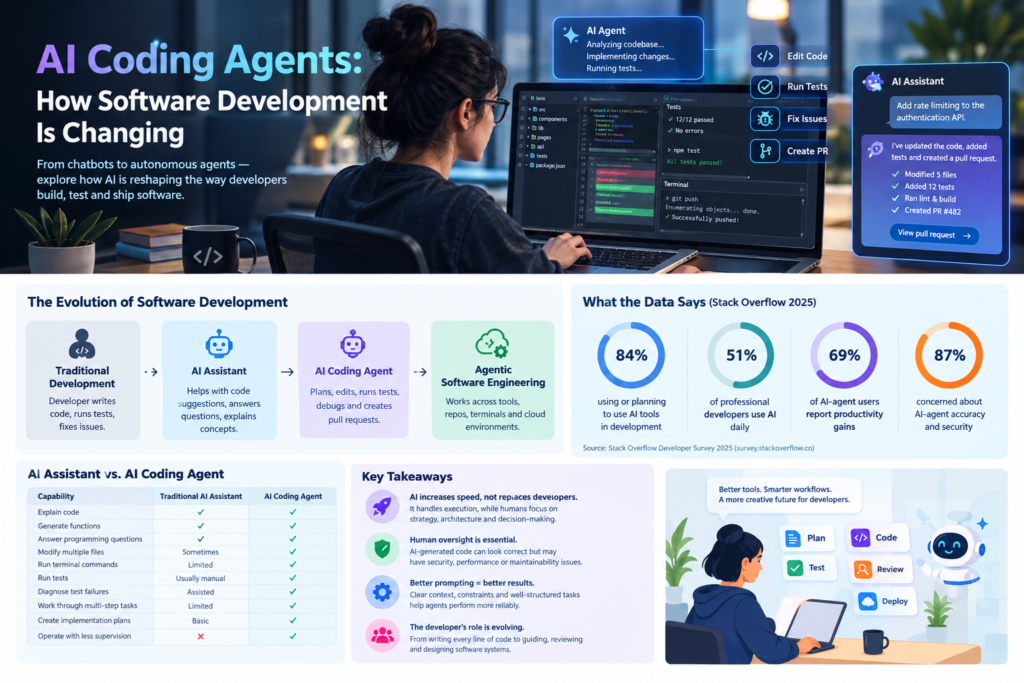
According to Stack Overflow’s 2025 Developer Survey, 84% of developers said they were using or planning to use AI tools in their development process, while 51% of professional developers reported using them daily.
At the same time, trust hasn’t caught up with adoption. More developers reported distrust of AI output accuracy than trust, showing that the future isn’t simply “AI replaces developers.” It is much more likely to be developers working with increasingly capable AI systems.
Key Takeaway: AI coding agents aren’t replacing the software development process they’re changing where humans spend their time. The developer increasingly becomes the person who defines the problem, guides the agent, validates its work, and makes the important engineering decisions.
From Code Completion to AI Coding Agents
The easiest way to understand the change is to compare traditional AI coding assistance with an agent.
A traditional AI assistant might work like this:
Developer → Prompt → AI → Code suggestion → Developer implements it
An AI coding agent aims for something closer to:
Developer → Goal → Agent plans → Agent edits files → Agent runs tools/tests → Agent fixes problems → Developer reviews
That distinction matters.
Tools such as OpenAI Codex are designed around end to end engineering tasks, including feature development, refactoring, migrations and pull requests. OpenAI describes Codex as supporting parallel agent workflows and background engineering tasks.
Meanwhile, AI enabled development environments are becoming increasingly common. Stack Overflow’s 2025 survey found growing usage of tools such as Cursor and Claude Code alongside established development environments.
AI Assistant vs. AI Coding Agent
| Capability | Traditional AI assistant | AI coding agent |
|---|---|---|
| Explain code | ✅ | ✅ |
| Generate functions | ✅ | ✅ |
| Answer programming questions | ✅ | ✅ |
| Modify multiple files | Sometimes | ✅ |
| Run terminal commands | Limited | ✅ |
| Run tests | Usually manual | ✅ |
| Diagnose test failures | Assisted | ✅ |
| Work through multi-step tasks | Limited | ✅ |
| Create implementation plans | Basic | ✅ |
| Operate with less supervision | ❌ | ✅ |
The difference isn’t that agents are magically better programmers. They have a larger action loop.
They can observe the project, make a change, evaluate the result, and continue.
How AI Coding Agents Actually Change the Developer Workflow
Key Takeaway: The biggest productivity opportunity isn’t asking AI to write isolated functions. It is giving an agent well defined engineering tasks that involve multiple steps while keeping humans responsible for validation.
Consider a simple backend task:
“Add rate limiting to our authentication API.”
A chatbot might explain how to use Redis and provide some Express.js code.
An agent could potentially:
- Inspect the existing authentication routes.
- Find the current middleware architecture.
- Check how Redis is configured.
- Implement rate limiting.
- Add or modify tests.
- Run the test suite.
- Investigate failures.
- Update documentation.
- Prepare a pull request.
This changes the economics of small engineering tasks.
Developers don’t have to spend as much time moving between the editor, terminal, documentation, tests and Git. The agent can become the connective layer between these activities.
For developers working with stacks such as React, Next.js, Node.js, Express, MongoDB and Redis, this can be particularly useful because many tasks involve coordinated changes across frontend, backend, APIs, database models and tests.
Poor requirements + poor repository structure + poor tests can still produce poor software just much faster.
Why Developers Are Still Needed
Key Takeaway: AI can generate implementation quickly, but software engineering involves constraints that aren’t always visible in code: architecture, security, business requirements, trade-offs, reliability and maintainability.
This is where the hype around AI coding agents needs some balance.
Stack Overflow’s 2025 survey found that 46% of developers distrust the accuracy of AI outputs, compared with 33% who trust them. Another 66% said their biggest frustration was receiving AI solutions that were “almost right, but not quite.”
That’s a familiar experience for anyone who has used AI for development.
An AI agent may produce code that:
- Compiles successfully but handles edge cases incorrectly.
- Passes existing tests but introduces a security problem.
- Follows the wrong architectural pattern.
- Uses an outdated library API.
- Solves the immediate problem while making future maintenance harder.
- Makes assumptions about business requirements.
The dangerous part isn’t obviously broken code.
It’s convincing code that looks correct.
That’s why experienced developers may actually become more valuable in an AI assisted environment. Their job isn’t necessarily to type faster than the model. Their value comes from knowing what should be built and how to determine whether it is correct.
The New Software Development Skill: Managing AI
Key Takeaway: Prompting is only one part of working with coding agents. The more valuable skill is learning how to provide context, define constraints, verify results and break complex work into manageable tasks.
A developer using AI effectively may spend less time writing code from scratch and more time doing things such as:
1. Defining clear tasks
Instead of:
“Build authentication.”
A better instruction might describe:
- Existing authentication architecture
- Database schema
- JWT requirements
- OAuth providers
- Token expiration
- Error-handling conventions
- Security requirements
- Required tests
The more precise the task, the fewer assumptions the agent has to make.
2. Reviewing generated changes
Git becomes especially important in an agent driven workflow.
Developers should review:
- Changed files
- Database migrations
- Authentication logic
- API behavior
- Dependencies
- Error handling
- Test coverage
- Security sensitive changes
3. Building strong automated tests
Tests become even more valuable when machines are writing code.
A good test suite gives an agent something concrete to evaluate:
Change → Test → Failure → Diagnosis → Fix → Test again
Without tests, the agent has fewer reliable signals telling it whether its work is actually correct.
4. Understanding architecture
If an agent can modify 20 files in seconds, understanding why those files should change becomes more important not less.
Developers still need to understand:
- API design
- Database modeling
- Authentication
- Caching
- Distributed systems
- Performance
- Security
- Deployment
- Observability
The abstraction level is simply moving upward.
What the Data Says About AI Agents
The adoption numbers tell an interesting story.
AI coding assistance is already widespread, but autonomous agents are still developing. Stack Overflow’s 2025 survey found that roughly one-third of developers were using AI agents, while 38% said they had no plans to adopt them. Among developers who used agents at work, 69% agreed that agents had increased their productivity.
At the same time, concerns remain significant: 87% of respondents expressed concerns about AI-agent accuracy and 81% had concerns about security or privacy.
That combination tells us something important.
AI agents are useful enough to create measurable productivity gains, but not reliable enough to remove human oversight.
And that’s probably the more realistic future of software development.
What Happens to Junior and Senior Developers?
Key Takeaway: AI changes the skill distribution inside development teams. Junior developers can gain powerful assistance, while senior developers increasingly spend time on architecture, review, debugging and system level decisions.
For junior developers, AI can act like an always-available programming partner.
It can explain unfamiliar code, generate examples, suggest debugging approaches and provide feedback.
But there is a risk.
If developers accept generated code without understanding it, they can become dependent on a system they don’t know how to evaluate.
For senior developers, the workflow may look different.
Instead of personally implementing every small change, they may:
Design → Delegate to AI → Review → Test → Refine → Ship
This makes software architecture and technical judgment increasingly important.
The strongest developers may not be those who avoid AI. They may be those who understand its strengths and weaknesses well enough to use it safely.
Where AI Coding Agents Are Heading
Key Takeaway: The next phase of AI assisted development is likely to involve longer running agents, better repository understanding, stronger testing loops and more integration with existing engineering workflows.
The direction is already visible.
Modern coding agents are increasingly being designed to operate across files, terminals, tests, development environments and cloud infrastructure.
OpenAI, for example, announced its Agents API in September 2026, describing infrastructure for long running agents that can use tools, work with files, run code and coordinate subagents.
That suggests an important evolution:
From AI that answers coding questions → AI that participates in engineering workflows.
Eventually, developers may give an agent a larger objective such as:
“Migrate this service from REST to a versioned API, preserve backward compatibility, update tests, document the migration and prepare the deployment changes.”
The developer then becomes the technical reviewer and decision-maker rather than manually coordinating every individual step.
That doesn’t eliminate engineering.
It raises the level at which engineering happens.
FAQ: AI Coding Agents
What is an AI coding agent?
An AI coding agent is an AI powered development system that can perform multi step software engineering tasks. Unlike basic coding chatbots, agents can often inspect files, modify code, execute commands, run tests and iterate on their work.
Are AI coding agents replacing developers?
Current evidence does not support treating AI agents as complete replacements for developers. Developers continue to be responsible for requirements, architecture, security, code review, testing and business decisions, while AI can automate portions of implementation.
Are AI coding agents safe to use?
They can be useful, but they should not automatically be trusted. Developer surveys show substantial concerns around accuracy, security and privacy, making code review, testing and appropriate access controls important.
Will developers still need to learn programming?
Yes. Understanding programming becomes particularly important when developers need to evaluate AI generated code, debug failures, design systems and make architectural decisions. AI can generate implementation, but developers still need to understand what the implementation should accomplish.
Conclusion: Software Development Is Becoming More Agentic
The most interesting thing about AI coding agents isn’t that they can write code.
It’s that they can increasingly participate in the process of building software.
We’re moving from:
Developer writes → AI suggests.